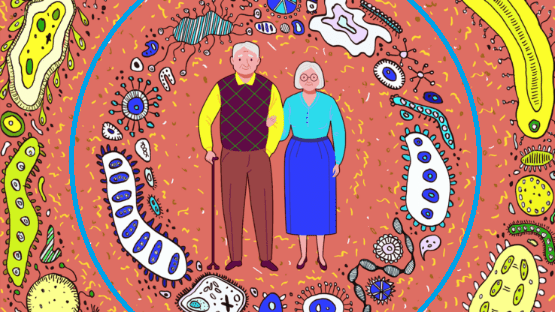
We are a super-organism composed of a galaxy of bacteria
We usually think of the human body as a relatively closed system: over time we have even coined the term innards precisely to define the parts “inside” our bodies-the viscera and especially the intestines. Actually, the shape of the human body is anything but closed and it is instead more like that of a tube, with the stomach and the intestines positioned inside our body but in fact in contact with the external environment.
The mucosa of the gastrointestinal tract is a major barrier between the individual and the external environment and serves as a surface for exchange with the environment. Its estimated surface area is about 32 m2, and it could fill the floor of a small study. The set of organisms that colonize this large surface area is called the gut microbiota: it is the set of bacteria, protists, fungi, and viruses that either temporarily live in or permanently colonize our gastrointestinal tract and that of all animals that possess one. These microorganisms originated well before us and evolved with us during millions of years of evolutionary history. Although we think of ourselves as “individuals,” we are actually the result of co-evolution with so many species of bacteria that make us a super-organism, or holobiont.
Dramatic changes occur in the early years of our lives as the infant’s gut changes from a sterile environment to a densely populated microbial habitat. These organisms provide us with many benefits through a variety of defense and nutrition functions. Their survival depends on us, and in return they defend us from pathogenic organisms and teach the immune system to distinguish friend from foe, degrade toxic compounds, break down dietary fibers that we are unable to digest into molecules important to our health (such as short-chain fatty acids), facilitate the absorption of minerals such as magnesium, calcium, and iron, and synthesize amino acids and some essential vitamins such as vitamin K and folate for us. Given its crucial functions, scientists now consider the gut microbiota to be a true additional organ.
The term microbiome means not only all these bacterial and non-bacterial species, but also the physiological and metabolic function they have for their host, namely us.
To understand the importance of the gut microbiota, let’s look at some numbers: it has been estimated that the number of microorganisms inhabiting our gastrointestinal tract is comparable to and greater than the number of all the cells in our body put together, furthermore, bacteria have many more genes than human cells, and while the entire human genome is composed of about 23,000 genes, our microbiome encodes more than 3 million genes that produce thousands of metabolites (molecules that are more or less useful to us). In other words, in terms of genes, humans are more than 99% microbial, and the more the bacterial diversity of our gut microbiome increases, the more our body gets benefits if these species are not pathogens.
Simply put, when it comes to the microbiome, diversity is richness.
Although there is a “core” made up of bacterial groups common to all healthy humans, and about one-third of the gut microbiota is common to most people, its composition in an adult person is mostly unique to each individual and is influenced by so many factors such as: nutrition at birth (breast milk or formula), antibiotic, antidiabetic and antidepressant drugs, eating habits and ways of cooking food, environment and lifestyle such as rural or urban places, and exercise.
The gut microbiota changes during the course of our life. While it is highly variable in infants, with age it tends to remain relatively stable and is accompanied by a reduction in diversity and loss of important genes, such as those involved in the production of short-chain fatty acids. This overall decrease in diversity has been linked to a greater fragility of our health status in general, but especially in old age. In addition, phenomena such as the progressive increase in antibiotic use, less and less outdoor activities, increased meat consumption and decreased consumption of raw vegetables are leading to a progressive decrease in the richness of our microbiota with increasingly strong alterations in its composition.
Strong alterations in the normal microbial composition of our gastrointestinal tract are also called dysbiosis and are associated with alterations in physiology and our metabolism, inflammatory bowel disease, colitis, gastritis, ulcers, irritable bowel syndrome, Crohn’s disease but also celiac disease, onset of diabetes mellitus, obesity, asthma, increased reactivity to stress, anxiety and depression, and even alterations in cognitive functions such as memory and spatial learning (i.e., the process by which we acquire a mental representation of our environment).
Basically, a diverse microbiota rich in different bacterial species that help us in a variety of ways is essential for staying physically and mentally healthy.
The good news is that many of the age-related changes in the gut microbiota are partly preventable through a healthy lifestyle. This means that taking care of your microbiota through a varied diet and active lifestyle is the best recipe for enjoying good health. Probiotics are live microorganisms that when administered in the correct ways and in sufficient quantities confer a benefit to our health and can change the physiological state of our gut by decreasing chronic inflammation and thus creating the conditions for a good immune system and stable health.
Over the course of an average human lifetime, about 60 tons of food pass through the gastrointestinal tract along with a large number of microorganisms from the external environment, posing a huge threat to the integrity of the gut and our health. The intestine is therefore much more than just a tube. It houses hundreds of trillions of microorganisms that participate in the digestion and defense functions of the gastrointestinal tract, and that influence our physical and mental health.
In conclusion, what we eat nourishes not only us, but also the galaxy of trillions of microorganisms living in our gut with enormous consequences on our health status. By supplementing our diet with fiber and foods fermented with probiotics, and being outdoors a lot more, we can help keep our microbiota stable and rich, and as a result, we can have a much stronger immune system and better physical and mental health even in old age.
 Simone Anzà, PhD — Life Science Researcher
I really like the idea of the gut microbiota as a real additional organ. It’s so important for overall health and well-being.
LikeLiked by 1 person
Thank you for your interest in my content! I believe this is an interesting new way of thinking about gut microbiome. It is probably also thanks to the huge contribution and influence of Fritjof Capra and his systemic thinking. And that is going to be the focus of my next content.
Stay tuned if interested in gut microbiome, health and new way of approaching science!
LikeLike